Tag archive for ‘arduino’
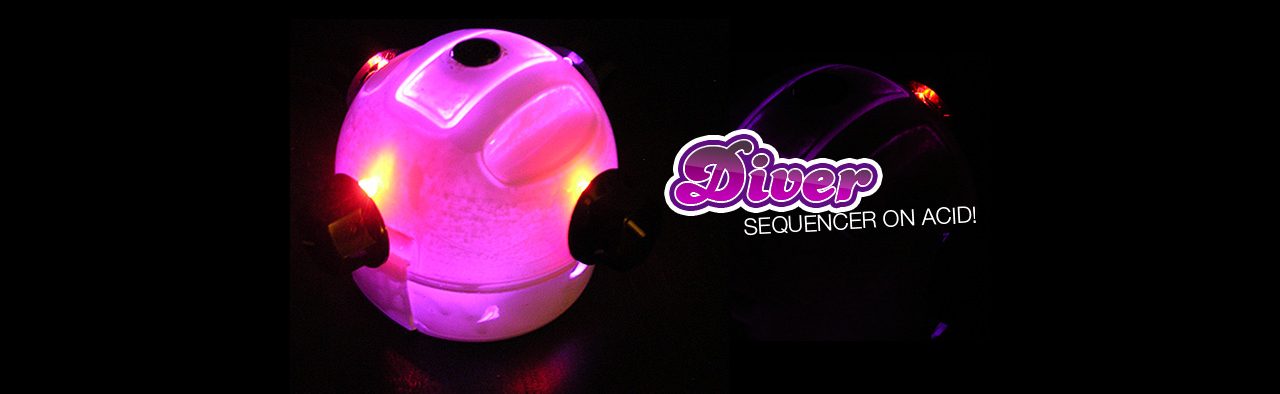
Diver: Sequencer on acid!

An Arduino sound project, Diver is an instrument inspired by old Analog Sequencers and Theremins. It allows creating a four-note looped melody which can be manipulated in real-time with knobs that can assign upto 5 octaves for each note. Each knob lights up to indicate it’s position in the loop.
The top of Diver houses a sensor which can be used to control the tempo of the loop in real-time. Use Diver in live performances or at home to produce awesome loops, melodies and special effects.
Videos
Photos
Tagged as arduino, audio, musical instrument, sequencer, sound + Categorized as Fun Experiments, @Parsons, Spring09, Major Studio: Computation, @Parsons, Spring09
Theremin like instrument: Prototype 2
Second prototype for the theremin style instrument. It is more of a sequencer now with 4 POT’s for changing frequencies in a looped melody and a sensor changing the tempo.
Tagged as arduino, computation, sound + Categorized as @Parsons, Spring09, Major Studio: Computation, @Parsons, Spring09
Theremin like instrument
This is the first implementation prototype of an instrument inspired by a theremin. The POT changes the frequency and the sensor adds another frequency to the mix. The idea is to create a theremin and an analog sequencer hybrid. I want to add 4 potentiometers to generate a looping melody and using the sensor to alter or add to it.
Tagged as arduino, audio, computation, musical instrument, sound + Categorized as @Parsons, Spring09, Major Studio: Computation, @Parsons, Spring09
Using an IR sensor to control LED’s and speaker
The IR sensor fades the LED’s in and out and changes the frequency sent to the speaker.
Tagged as arduino, breadboard, computation, LED, sound + Categorized as @Parsons, Spring09, Major Studio: Computation, @Parsons, Spring09
Using a POT to control 2 LED’s and a speaker
The POT fades the blue LED in and out, increases/decreases the blinking speed of the green LED and changes the speed and frequency of the sound on the speaker.
Tagged as arduino, breadboard, computation, LED, sound + Categorized as @Parsons, Spring09, Major Studio: Computation, @Parsons, Spring09
User testing: Tweetlite
I tested the Tweetlite on 2 potential users. They both thought the product was marketable, would appeal to the Twitter community and gave me some great feedback.
Tagged as arduino, computation, LED, passage of time, time piece + Categorized as @Parsons, Spring09, Major Studio: Computation, @Parsons, Spring09
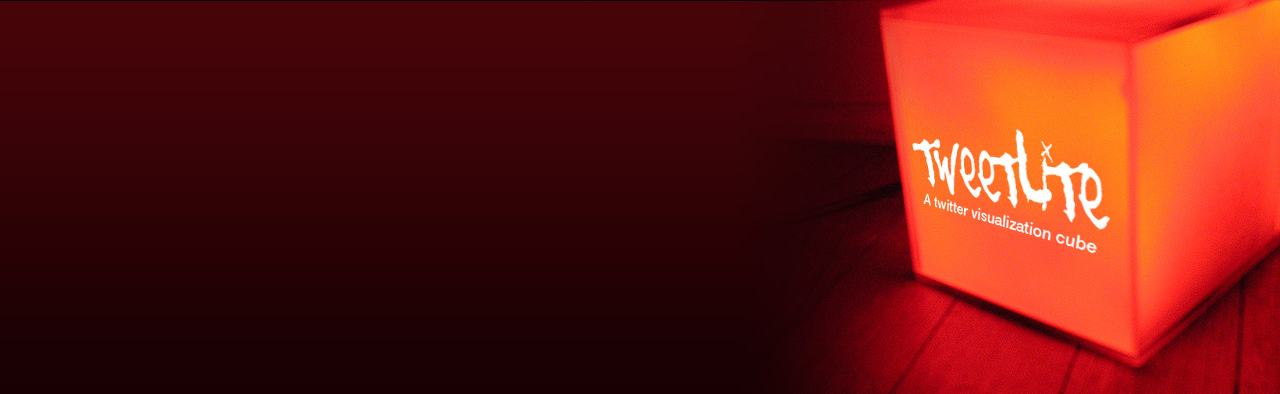
Tweetlite: A twitter visualization cube

Tweetlite is a visual commentary on our relationship with online social networks. It is an ambient light that represents a pixel – the smallest unit of visual digital information.
This is represented in the form of a minimalist, 4″ white, plexiglass, cube that reads messages from a Twitter feed and displays them in Morse code.
Each message is displayed in a different color and makes for a great mood light. It has USB and power connectivity and comes with a program that is used to enter Twitter credentials to enable the data feed visualization. It needs to be connected to a computer with an Internet connection, via USB. The patterns and colors can be customized. Needless to say, it can be of great use to someone who can read, interpret or even want to learn Morse code.
It is powered by Arduino and Python. The code is based off of example found here. If anyone is interested in building one I can post a tutorial, let me know.
Videos
Photos
Tagged as arduino, computation, LED, passage of time, time piece + Categorized as Fun Experiments, @Parsons, Spring09, Major Studio: Computation, @Parsons, Spring09
Passage of time v3.0 with PWM
I added PWM to the fifth iteration of my Passage of Time project. The switches still work as in the previous version – the rocker switch for on/off, the toggle for switching patterns and the pushbutton to add in a third pattern. The PWM support only 6 of the 12 LED’s in the time piece and the second pattern augments the fade in/out with additional non PWM LED’s.
Tagged as arduino, passage of time, time piece + Categorized as @Parsons, Spring09, Major Studio: Computation, @Parsons, Spring09
Using PWM with multiple LED’s
This was part of a student lecture in the computation class. We discussed PWM and applying it to multiple LED’s and tri-color LED’s. Here’s pcitures and code for the 2 circuits I built and presented in class.
Multiple LED’s with PWM
Code:
Tri-Color LED
Code:
Tagged as arduino, breadboard, computation, LED + Categorized as @Parsons, Spring09, Major Studio: Computation, @Parsons, Spring09
Passage of time v2.5 with Switches
I added switches to the fourth iteration of the passage of time. 1 rocker switch for on/off, 1 toggle switch which switches between 2 patterns, 1 momentary pushbutton switch that changes the pattern when the toggle switch is up. The switches are mounted on a separate short box with holes drilled using the dremel tool and attached to the bottom of the taller box. All the switches are hooked up to the Arduino using a breadboard.
Passage of time with switches from Bruce Drummond on Vimeo.
Tagged as arduino, breadboard, computation, LED, passage of time, time piece + Categorized as @Parsons, Spring09, Major Studio: Computation, @Parsons, Spring09